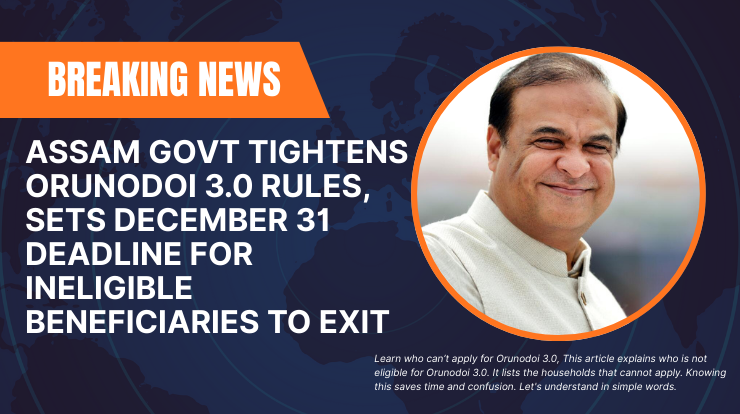
Guwahati: The Government of Assam has issued a strict directive to enforce the exclusion criteria under the Orunodoi 3.0 scheme, warning that ineligible beneficiaries who do not opt out by December 31, 2025, will face disciplinary action and recovery of benefits.
In an official communication issued by the Assam Finance Department, the state government reiterated that government employees, pensioners, teachers, and their dependent family members are not eligible to receive benefits under the Orunodoi scheme. The department referred to the Orunodoi notification dated September 19, 2024, which clearly lays down the exclusion rules under Paragraph 2.4.
As per the notification, teachers working in universities, colleges, higher secondary schools, high schools, upper primary and lower primary schools are barred from availing the scheme. This exclusion applies to teachers appointed on a regular, contractual, or temporary basis.
The directive further stated that all regular and contractual government employees and pensioners are ineligible for Orunodoi benefits. The exclusion also covers workers associated with government-supported services, including Anganwadi workers, Mid-Day Meal workers, ASHA workers, ASHA supervisors, and Gaon Pradhans.
See More:
The Finance Department has made it mandatory for any such ineligible government employee or their dependent family members who are currently receiving Orunodoi assistance to compulsorily opt out of the scheme within the stipulated deadline.
The department warned that failure to opt out will result in stern disciplinary action under applicable service rules, along with recovery of the financial assistance wrongly availed.
To ensure effective implementation of the directive, the state government has instructed all senior-most secretaries to circulate the order to subordinate offices and ensure strict compliance across departments.
The Orunodoi scheme is one of Assam’s flagship welfare initiatives and is aimed at providing monthly financial assistance to economically vulnerable households, with a special focus on women-led families.
Source: The Sentinel