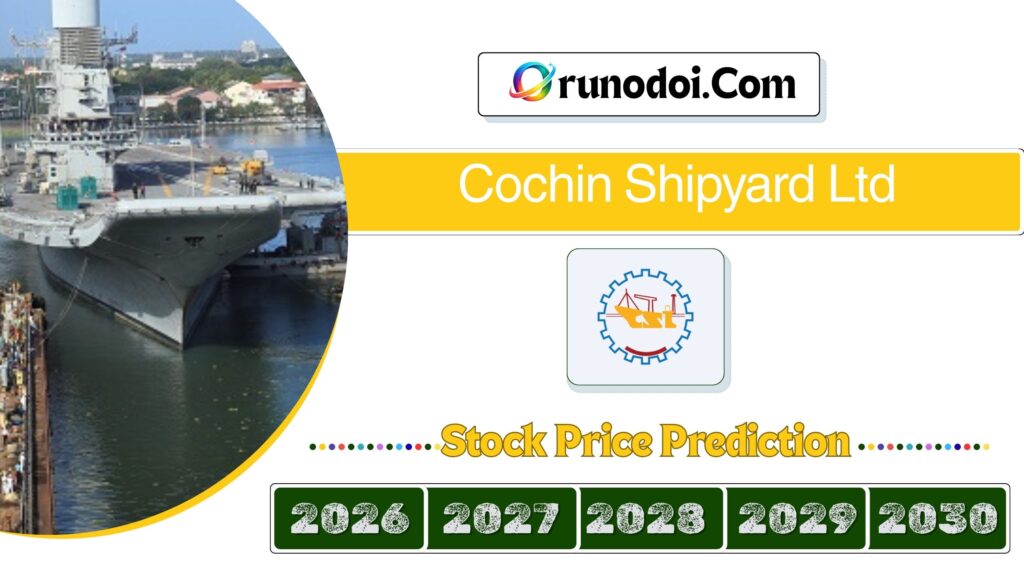
Cochin Shipyard Limited (CSL) is India’s largest public sector shipbuilding and repair facility, playing a strategic role in the country’s maritime and defense infrastructure. Headquartered in Kochi, Kerala, the company builds and repairs commercial vessels, naval ships, and offshore support vessels for both domestic and international clients. With strong government backing, near-zero debt, and consistent order inflows from the Indian Navy and Coast Guard, Cochin Shipyard remains a key player in India’s “Atmanirbhar Bharat” (self-reliance) push in defense manufacturing. This article provides a fact-based outlook on its share price target for each year from 2026 through 2030.
Shipbuilding: Naval vessels (warships, frigates), commercial ships (bulk carriers, tankers), and offshore support vessels
Ship Repair & Refit: Periodic maintenance, life extension, and modernization of vessels
Strategic Importance:
Built India’s first indigenous aircraft carrier, INS Vikrant
Only Indian shipyard capable of building large warships and aircraft carriers
Global Reach: Exported over 45 ships to Europe, Africa, and the Middle East
Ownership: 67.91% held by the Government of India (Ministry of Ports, Shipping & Waterways)
Cochin Shipyard: Key Financial Snapshot
Metric
Value
Market Capitalization
₹39,472.64 Cr
Current Share Price
₹1,500 (as of Feb 2026)
P/E (TTM)
55.49
P/B (TTM)
6.68
Book Value (TTM)
₹224.64
EPS (TTM)
₹27.04
ROE
15.85%
ROCE
22.15%
Dividend Yield
0.65%
Sales Growth (TTM)
24.21%
Profit Growth (TTM)
3.67%
Cash Reserves
₹3,021.22 Cr
Debt
₹23.02 Cr (virtually debt-free)
Face Value
₹5
Note: While sales grew robustly (24%), profit growth lagged at just 3.7%, likely due to cost overruns in complex naval projects and lower-margin repair work.
High P/E (55x) is unjustified by the current earnings trajectory
Cyclical exposure to defense budget allocations
Minimal dividend yield (0.65%) offers no income cushion
Investment Suitability
Factor
Assessment
Risk Profile
Moderate to High
Time Horizon
Long-term (5+ years)
Volatility
Moderate
Dividend/Income
Very low (0.65% yield)
Ideal Investor
Patriotic or thematic investor betting on India’s naval expansion and defense indigenization
FAQs
A realistic range is ₹1,600 to ₹1,850, based on the current order book and execution momentum.
Credible estimates suggest ₹2,200 to ₹2,900 by 2030, assuming sustained ROCE and defense tailwinds.
Reliable forecasts beyond 2030 are not possible. Such long-term projections are speculative and not based on verifiable data.
The Government of India holds 67.91% through the Ministry of Ports, Shipping & Waterways.
Yes. It has a consistent dividend history with a current yield of 0.65% and a payout ratio of ~35%.
The stock corrected due to disappointing profit growth (3.7%), high valuation (P/E > 55), and concerns over project delays in naval programs.
Yes. It carries only ₹23.02 crore in debt, making it effectively debt-free with massive cash reserves.
Final Verdict
Cochin Shipyard is a strategically vital asset in India’s defense ecosystem with unmatched capabilities in naval shipbuilding. While its sales are growing strongly, profit conversion remains weak, limiting near-term upside. Our 2026–2030 price targets (₹1,600–₹2,900) reflect cautious optimism—rewarding national importance but capping upside due to execution risks. Best suited for investors with a 5-year horizon who believe in India’s maritime sovereignty story.
Disclaimer: This article is for educational purposes only. It is not investment advice. Please consult a SEBI-registered advisor before making any investment decision.
Hi, I’m Raj Mittal, a stock market content writer focused on company analysis, share price trends, and fundamental research. I create simple, research-based insights to help investors make smarter market decisions.