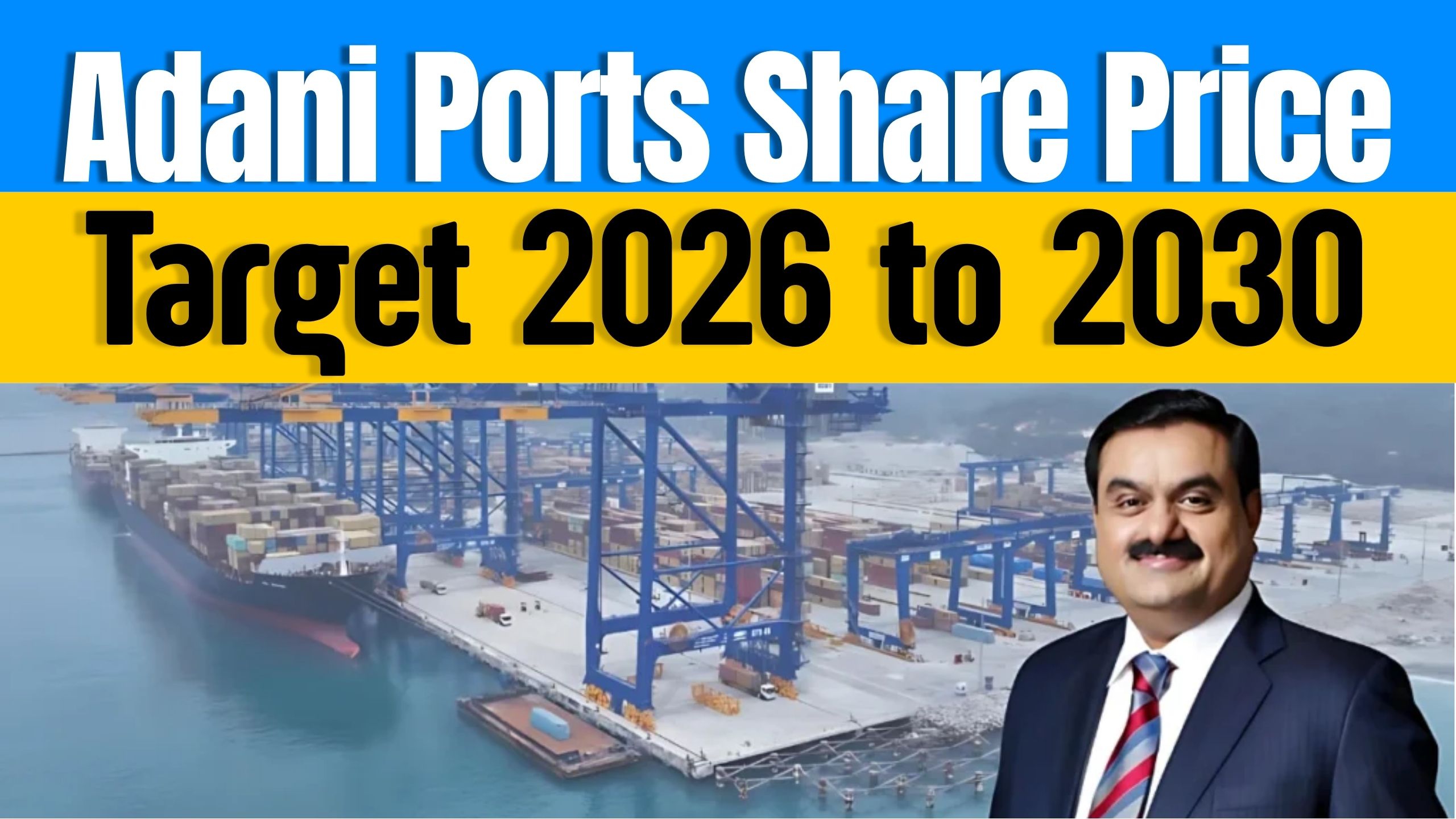
Adani Ports and Special Economic Zone Limited (APSEZ) is India’s largest private port operator and a key player in the country’s logistics and infrastructure ecosystem. Headquartered in Ahmedabad, the company operates 15 ports across India—including the flagship Mundra Port—and has expanded its footprint internationally with terminals in Haifa (Israel), Colombo (Sri Lanka), and Dar es Salaam (Tanzania). Beyond port operations, APSEZ is developing integrated multi-product Special Economic Zones (SEZs), logistics parks, and rail connectivity to create end-to-end supply chain solutions. As of January 2026, the company benefits from strong government support for infrastructure development and rising cargo demand, but faces investor concerns over high debt and elevated valuations. This article provides a data-driven outlook on the Adani Ports share price target 2026–2030.
Adani Ports & Special Economic Zone: Company Overview
Founded: 1998
- Managing Director: Mr. Gautam Adani
- NSE Symbol: ADANIPORTS
- Core Business: Port operations (70%), Logistics & Transport (20%), SEZ & Infrastructure (10%)
- Market Position: Largest private port operator in India with ~24% market share; handles over 633 MMT of cargo annually
APSEZ is strategically positioned to benefit from India’s push toward self-reliance in trade, PLI schemes, and global supply chain diversification away from China. The company aims to double its cargo capacity by 2030 and expand its international portfolio.
Adani Ports & Special Economic Zone: Key Financial Snapshot
| Metric | Value |
|---|---|
| Current Share Price | ₹1,397 |
| Market Capitalization | ₹3,22,945.95 Cr |
| No. of Shares Outstanding | 230.40 Cr |
| 52-Week High / Low | ₹1,605 / ₹994 |
| P/E Ratio (TTM) | 156.51 |
| P/B Ratio | 10.80 |
| EPS (TTM) | ₹8.96 |
| Book Value (TTM) | ₹129.80 |
| ROE | 8.27% |
| ROCE | 9.10% |
| Dividend Yield | 0.50% |
| Face Value | ₹2 |
| Cash | ₹1,643.52 Cr |
| Debt | ₹51,472.76 Cr |
| Promoter Holding | 68.02% |
| Sales Growth (YoY) | 16.22% |
| Profit Growth (YoY) | 41.35% |
Adani Ports Share Price Target Forecast (2026–2030)
| Year | Target Price Range (₹) |
|---|---|
| 2026 | ₹1,480 – ₹1,620 |
| 2027 | ₹1,580 – ₹1,750 |
| 2028 | ₹1,680 – ₹1,900 |
| 2029 | ₹1,780 – ₹2,100 |
| 2030 | ₹1,880 – ₹2,300 |
Adani Ports Share Price Target 2026
| Year | Share Price Target 1 | Share Price Target 2 |
|---|---|---|
| 2026 | ₹1,480 | ₹1,620 |
Adani Ports reported 41.35% YoY profit growth in FY2025, driven by volume expansion at Mundra and new terminals. However, its P/E of 156x is extremely high compared to sector peers (avg. P/E: 28x), reflecting stretched valuations. The 2026 target range assumes:
- Moderate earnings growth (15–18%)
- No major regulatory or geopolitical disruptions
- Gradual deleveraging from current debt of ₹51,472 Cr
Adani Ports Share Price Target 2027
| Year | Share Price Target 1 | Share Price Target 2 |
|---|---|---|
| 2027 | ₹1,580 | ₹1,750 |
If the company sustains cargo volume growth and improves EBITDA margins through operational efficiency, EPS could reach ₹10–₹11 by FY27. Assuming a P/E contraction to 140–150x (still premium), the 2027 target is justified.
Adani Ports Share Price Target 2028
| Year | Share Price Target 1 | Share Price Target 2 |
|---|---|---|
| 2028 | ₹1,680 | ₹1,900 |
By 2028, benefits from international assets and SEZ monetization should reflect in cash flows. A P/E of 130–140x on projected EPS of ₹12–₹13 supports the ₹1,680–₹1,900 band.
Adani Ports Share Price Target 2029
| Year | Share Price Target 1 | Share Price Target 2 |
|---|---|---|
| 2029 | ₹1,780 | ₹2,100 |
Long-term tailwinds include India’s $1.3 trillion infrastructure push and global trade realignment. If competition doesn’t erode pricing, EPS could reach ₹14–₹15 by FY29. At a P/E of 120–130x, the 2029 target is achievable.
Adani Ports Share Price Target 2030
| Year | Share Price Target 1 | Share Price Target 2 |
|---|---|---|
| 2030 | ₹1,880 | ₹2,300 |
Over a five-year horizon, APSEZ remains a strategic infrastructure play—but its valuation leaves little room for error. A terminal P/E of 110–120x on FY30 EPS (~₹17–₹19) justifies the ₹1,880–₹2,300 range.
Adani Ports: Shareholding Pattern
| Category | Holding (%) |
|---|---|
| Promoters | 68.02% |
| Domestic Institutional Investors (DII) | 13.90% |
| Foreign Institutional Investors (FII) | 13.09% |
| Public & Others | 4.99% |
High promoter holding ensures strategic continuity. However, the FII stake has declined from 18% in 2023 due to ESG and governance concerns.
Adani Ports: Strengths vs Risks
Strengths:
- Monopoly-like position in the private port sector
- Strong alignment with national infrastructure goals
- International expansion reduces India’s dependency
- Consistent volume growth (16%+ sales CAGR over 5 years)
Risks:
- Extremely high P/E (156x) offers no margin of safety
- Net debt/EBITDA of ~4.5x limits financial flexibility
- Regulatory scrutiny on related-party transactions
- Contingent liabilities of ₹1.2 lakh Cr require monitoring
Investment Suitability
| Factor | Assessment |
|---|---|
| Risk Profile | High |
| Ideal Time Horizon | 5+ years |
| Volatility | Higher than market average |
| Dividend/Income Potential | Very low (0.5% yield) |
| Best For | Aggressive investors are betting on India’s trade infrastructure boom |
FAQs
What is the share price target for Adani Ports and Special Economic Zone?
Based on fundamentals and sector trends, the Adani Ports share price target for 2026 is ₹1,480 – ₹1,620.
What is Adani Ports and Special Economic Zone?
It is India’s largest private port operator, managing 15 domestic ports and 3 international terminals. It also develops logistics parks and multi-product SEZs adjacent to ports.
What is the rate of Adani Ports today?
As of January 13, 2026, the Adani Ports share price is ₹1,397.
Is ADANI port a good buy?
Only for high-risk, long-term portfolios. Avoid if you seek value, dividends, or low volatility. The stock is overvalued on traditional metrics but offers structural growth potential.
Why is Adani crashing?
The broader Adani Group faced sharp corrections in 2023–2024 due to Hindenburg allegations and debt concerns. While APSEZ has recovered, sentiment remains fragile during market stress. However, operational performance has not deteriorated—profit growth is robust at 41%.
Why is Adani Port falling?
Adani Ports may correct due to:
- Overvaluation (P/E > 150x)
- Broader market rotation away from high-multiple stocks
- Concerns over group-wide leverage and corporate governance
However, fundamentals remain strong—volume growth and profitability are intact.
Final Verdict
Adani Ports is a high-quality business trading at a very rich valuation. Its dominance in Indian port logistics and global expansion make it a compelling long-term story—but current multiples price in near-perfect execution.
Our Adani Ports share price target 2026–2030 (₹1,480 to ₹2,300) reflects cautious optimism: upside is limited by valuation, while downside is cushioned by monopoly economics and policy tailwinds.
Disclaimer: Price targets are estimates based on publicly available data and sector analysis. They are not investment advice. Consult a SEBI-registered advisor before making decisions.
Sources
- Screener.in – Adani Ports Consolidated Page (FY2025 + TTM)
- Finology Ticker – ADANIPORTS Financials & Analysis
- Groww.in – Adani Ports Stock Profile
- Adani Ports Investor Presentation (Q3 FY26, Jan 2026)
- Ministry of Shipping, Government of India – National Maritime Agenda 2030