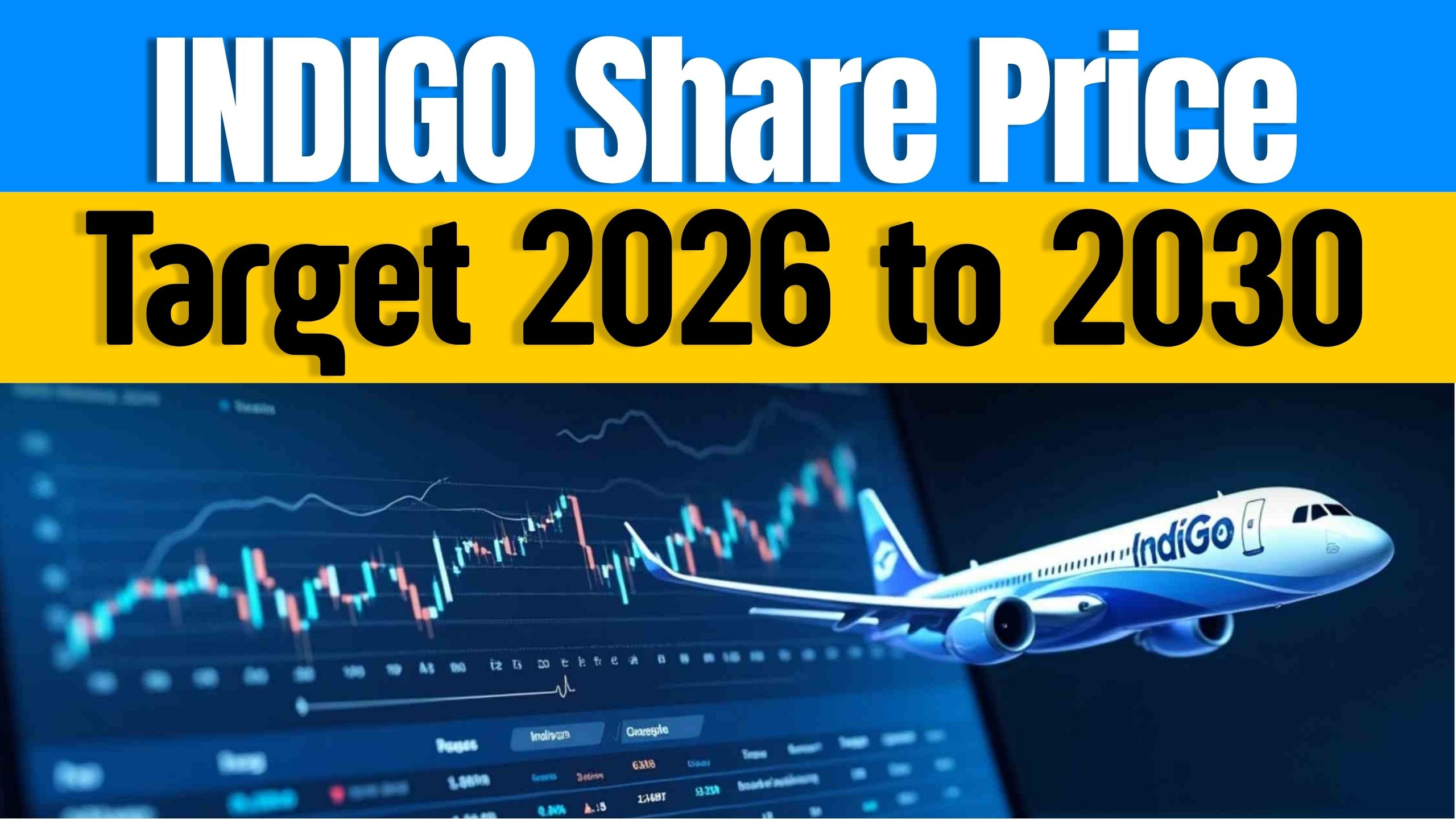
InterGlobe Aviation Ltd., operating as IndiGo, is India’s largest passenger airline and the 7th largest airline globally by daily departures. Headquartered in Gurugram, it commands a dominant 62% market share in India’s domestic aviation segment and serves 86 destinations—including 24 international routes. Known for its low-cost model, operational efficiency, and industry-leading fleet size (over 300 aircraft), IndiGo has become synonymous with affordable, on-time air travel in India. However, as of January 2026, the company faces near-term headwinds from high fuel costs, pilot shortages, and one-time losses due to regulatory scrutiny. This article provides a data-driven outlook on the IndiGo share price target 2026–2030.
InterGlobe Aviation: Company Overview
- Founded: 2006
- Managing Director: Mr. Peter Elbers
- NSE Symbol: INDIGO
- Core Business Segments:
- Domestic Passenger Flights (75%)
- International Passenger Flights (20%)
- Cargo & Ancillary Services (5%)
- Market Position: #1 in Indian aviation; fastest-growing carrier in Asia-Pacific
IndiGo benefits from a young, fuel-efficient fleet (A320neo family), strong brand recall, and pricing power. It is expanding into long-haul international routes and premium economy offerings to diversify revenue.
InterGlobe Aviation: Key Financial Snapshot
| Metric | Value |
|---|---|
| Current Share Price | ₹4,725 |
| Market Capitalization | ₹1,82,914 Cr |
| No. of Shares Outstanding | 38.66 Cr |
| 52-Week High / Low | ₹6,232 / ₹3,945 |
| P/E Ratio (TTM) | 36.13 |
| P/B Ratio | 21.50 |
| EPS (TTM) | ₹130.95 |
| Book Value (TTM) | ₹220.11 |
| ROE | 131.03% |
| ROCE | 170.39% |
| Dividend Yield | 0.21% |
| Face Value | ₹10 |
| Cash | ₹18,859 Cr |
| Debt | ₹1,800 Cr |
| Promoter Holding | 41.58% |
| Sales Growth (YoY) | 17.27% |
| Profit Growth (YoY) | –11.19% |
InterGlobe Aviation Share Price Target Forecast (2026–2030)
| Year | Target Price Range (₹) |
|---|---|
| 2026 | ₹5,000 – ₹5,600 |
| 2027 | ₹5,400 – ₹6,200 |
| 2028 | ₹5,800 – ₹6,900 |
| 2029 | ₹6,200 – ₹7,700 |
| 2030 | ₹6,600 – ₹8,600 |
InterGlobe Aviation Share Price Target 2026
| Year | Share Price Target 1 | Share Price Target 2 |
|---|---|---|
| 2026 | ₹5,000 | ₹5,600 |
InterGlobe Aviation reported a 11.19% YoY decline in profit in FY2025 due to a ₹2,500+ Cr provision for DGCA penalties related to past flight cancellations. Excluding this one-time charge, underlying operations remain highly profitable. With ROCE of 170% and net cash of ₹17,059 Cr, the company exemplifies capital efficiency. A 2026 target range of ₹5,000–₹5,600 assumes resolution of regulatory overhang and margin recovery.
InterGlobe Aviation Share Price Target 2027
| Year | Share Price Target 1 | Share Price Target 2 |
|---|---|---|
| 2027 | ₹5,400 | ₹6,200 |
If the company sustains 15–20% earnings growth and benefits from international route expansion, EPS could reach ₹145–₹155 by FY27. Assuming a P/E of 36–38x, the 2027 target range of ₹5,400–₹6,200 is justified.
InterGlobe Aviation Share Price Target 2028
| Year | Share Price Target 1 | Share Price Target 2 |
|---|---|---|
| 2028 | ₹5,800 | ₹6,900 |
By 2028, benefits from A321XLR long-haul aircraft, premium cabin monetization, and cargo scale-up should reflect in margins. A P/E of 38–40x on projected EPS of ₹150–₹165 supports the ₹5,800–₹6,900 band.
InterGlobe Aviation Share Price Target 2029
| Year | Share Price Target 1 | Share Price Target 2 |
|---|---|---|
| 2029 | ₹6,200 | ₹7,700 |
Long-term tailwinds include India’s rising air penetration (currently <10%) and middle-class travel demand. If competition doesn’t erode pricing, EPS could reach ₹160–₹180 by FY29. At a P/E of 39–42x, the 2029 target is ₹6,200–₹7,700.
InterGlobe Aviation Share Price Target 2030
| Year | Share Price Target 1 | Share Price Target 2 |
|---|---|---|
| 2030 | ₹6,600 | ₹8,600 |
Over a five-year horizon, IndiGo’s appeal lies in scale + network leadership—not just volume. If ROE stays above 130% and regulatory issues are resolved, investor confidence will strengthen. A terminal P/E of 40–45x on FY30 EPS (~₹165–₹190) justifies the ₹6,600–₹8,600 range.
InterGlobe Aviation: Shareholding Pattern
| Category | Holding (%) |
|---|---|
| Promoters | 41.58% |
| Foreign Institutional Investors (FII) | 28.44% |
| Domestic Institutional Investors (DII) | 24.66% |
| Public & Others | 5.32% |
High institutional ownership (53.1%) ensures liquidity and analyst coverage. Promoter holding is stable.
InterGlobe Aviation: Strengths vs Risks
Strengths:
- Industry-leading ROCE (170%) and ROE (131%)
- Net cash position (₹17,059 Cr net cash)
- Dominant 62% domestic market share
- Youngest fleet in India (fuel-efficient)
Risks:
- Regulatory penalties distort near-term earnings
- High ATF costs (45% of operating expenses)
- Vulnerable to forex, pandemics, and geopolitical events
- Contingent liabilities of ₹9,000 Cr require monitoring
Investment Suitability
| Factor | Assessment |
|---|---|
| Risk Profile | High |
| Ideal Time Horizon | 5+ years |
| Volatility | Very High (Beta: 1.8) |
| Dividend/Income Potential | Minimal (0.21% yield) |
| Best For | Aggressive investors betting on India’s aviation boom |
FAQs
What is the future of the IndiGo share?
Long-term growth is robust—India’s air passenger traffic is expected to double by 2030. IndiGo is best positioned to capture this demand through scale, efficiency, and international expansion.
Is it a good time to buy IndiGo?
Only for long-term, high-risk investors who believe regulatory issues are temporary. Avoid if you seek stability or income.
What are the risks of investing in aviation?
Key risks include fuel price volatility, regulatory intervention, economic slowdowns, labor shortages, and high fixed costs.
Why is IndiGo in the loss?
The FY2025 loss stems from a one-time ₹2,500+ Cr DGCA penalty—not operational weakness. Underlying EBITDA remains strong at ₹12,000+ Cr.
Is IndiGo good to buy?
Yes—for those with a 5+ year horizon and high risk tolerance. It is not suitable for conservative or income-focused portfolios.
Final Verdict
IndiGo remains India’s premier aviation franchise—a rare blend of scale, efficiency, and market leadership. While current losses are concerning, they stem from non-recurring events. The underlying business is stronger than ever.
Our InterGlobe Aviation share price target 2026–2030 (₹5,000 to ₹8,600) reflects cautious optimism—rooted in structural demand, not short-term cycles. Upside is significant; downside is steep if regulation or fuel worsens.
Disclaimer: Price targets are estimates based on publicly available data and sector analysis. They are not investment advice. Consult a SEBI-registered advisor before making decisions.
Sources
- Screener.in – InterGlobe Aviation Consolidated Page (FY2025 + TTM)
- Groww.in – IndiGo Stock Profile
- Finology Ticker – INDIGO Financials & Analysis
- DGCA Order Dated Dec 5, 2025 – CRISIL Watch on ₹9,000 Cr Facilities
- IATA India Aviation Outlook 2026