
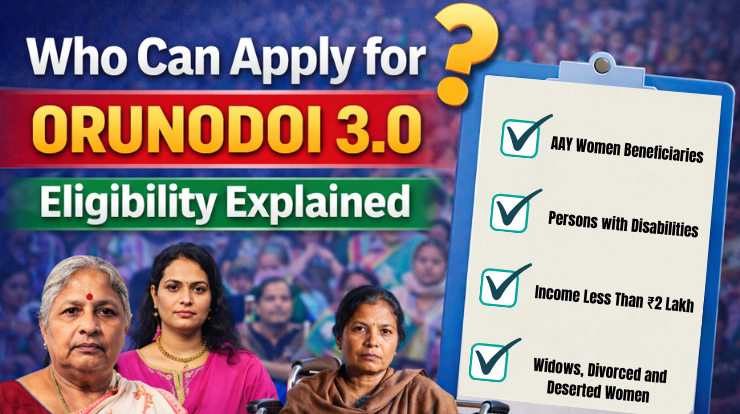
Orunodoi 3.0 is Assam’s important financial assistance scheme. It provides monthly help to families. The aim is to support women in need. Many people ask, “Who can apply for Orunodoi 3.0?” It is important to know the rules.
This guide explains the Orunodoi 3.0 eligibility in very simple words. We will use only the official government categories. Let us understand who the Orunodoi scheme beneficiaries can be.
Who Can Apply for Orunodoi 3.0?
The government has set clear groups. You must fit into one of these groups to be considered. Here is the complete Orunodoi eligibility criteria for Assam explained simply.
Table of Contents
1. Widows and Unmarried Women (Above 45 Years)
- Explanation: If a woman’s husband has passed away, she is a widow. Also, if a woman is not married and is over 45 years old, she can apply.
- Example: Mina Baidew is 50 years old and never married. She lives alone and finds it hard to earn. She can apply.
- Why this group? These women often have no steady family support. The scheme gives them a safety net.
2. Divorced and Deserted Women
- Explanation: This includes women who are legally divorced. It also includes women left by their husbands without support.
- Example: Priyanka’s husband left her five years ago. She has no news of him and manages her children alone. She falls under this group.
- Why this group? These women face social and economic challenges. They need extra help to live with dignity.
3. Transgender Persons
- Explanation: Transgender persons are fully eligible to apply for the Orunodoi scheme.
- Example: Rohan, who identifies as a transgender person, struggles to find stable work. Rohan can apply under this category.
- Why this group? Transgender persons often face discrimination. The scheme ensures they are not left behind.
4. Persons with Disabilities (Irrespective of Gender)
- Explanation: Any person, man or woman, who has a disability (40% or more) can apply.
- Example: Biren has a physical disability from birth. He finds it difficult to do many jobs. Biren is eligible to apply.
- Why this group? Disabilities can make earning a regular income very hard. This support helps with daily needs.
5. Old or Infirm Women
- Explanation: This is for elderly or very weak women. It also includes women living in government old-age homes.
- Example: 70-year-old Geeta Baidew is weak and cannot work. She lives with her sister’s family. She is eligible.
- Why this group? They cannot earn and depend on others for care. The scheme provides direct financial help.
6. Women from Households with Disabled or Senior Citizen Earning Members
- Explanation: If the main earning person in the house is disabled or a senior citizen (above 60 years), the woman of that house can apply.
- Example: In Mala’s family, her father (70 years old) is the only earner. Mala, as the woman in the household, can apply.
- Why this group? The family’s income is limited and uncertain. The woman gets help to manage household expenses.
7. Women from Households with Members Having Specific Illnesses
- Explanation: If a family member who earns has these major illnesses: HIV, Thalassemia, Haemophilia, Cerebral Palsy, Leprosy, or Autism, the woman can apply.
- Example: Rita’s husband has Thalassemia. He cannot work regularly. Treatment costs are high. Rita, as the woman in the house, is eligible.
- Why this group? These illnesses require long-term care and cost. The family needs extra financial support.
8. Women Without Shelter and Destitute Women Living on Alms
- Explanation: This is for women who have no proper home. It also includes very poor women who survive by begging.
- Example: Sunita lives in a temporary hut and depends on charity for food. She can apply under this group.
- Why this group? They are in the most vulnerable situation. The scheme aims to give them basic security.
9. Antyodaya Anna Yojana (AAY) Women Beneficiaries
- Explanation: If a woman already has an AAY ration card (the poorest families card), she is eligible.
- Example: Manika has a pink AAY ration card. She is automatically on the Orunodoi scheme beneficiaries list to be considered.
- Why this group? The AAY card already identifies the poorest families. It makes the selection process smoother.
10. Women from Households with Yearly Income Less Than ₹2 Lakh
- Explanation: This is a general rule. If the total income of all family members is less than ₹2 lakh per year, the woman can apply.
- Example: All the members in Tulsi’s family earn money. Their total income in a year is ₹1,80,000. Tulsi is eligible based on this income condition.
- Why this group? This covers all very low-income families who may not fall into other groups but still need help.
Income Condition Explained Simply
“Composite yearly income less than ₹2 lakh” means you add ALL the money earned by ALL family members in one year. If the total is less than ₹2,00,000 (Two Lakh Rupees), the condition is met.
- Simple Example: Father earns ₹12,000/month = ₹1,44,000/year. Son earns ₹4,000/month = ₹48,000/year. Total = ₹1,92,000/year. This is less than ₹2 lakh.
Important Things to Remember
- One Woman Per House: Only one woman from one household can get the benefit.
- Government Selection: Your application is checked by local committees. Final eligibility for the Orunodoi scheme is decided by them.
- Offline Application: You apply at your local Circle Office or via Anganwadi workers. There is no online application for Orunodoi 3.0.
- Verification is Key: Filling a form does not guarantee approval. Officials will verify your details.
Common Misunderstandings
- Not for Everyone: Who is eligible for the Orunodoi scheme? Only those in the listed groups. Being poor is not the only condition.
- No Online Form: Do not trust websites asking for online applications. The process is offline.
- No Guarantee: Meeting the Orunodoi 3.0 eligibility criteria means you can apply. It does not mean you will 100% be selected.
To summarize who can apply for Orunodoi 3.0, the main eligible persons are widows, unmarried women above 45, divorced women, transgender persons, persons with disabilities, and women from very low-income or illness-affected families. The Orunodoi eligibility criteria for Assam are designed to reach the most vulnerable people first.
Always rely on information from official government notices or your local Circle Office. If you believe you fit into one of these groups, you can inquire about the application process. This scheme is a step to provide dignity and support to those who need it most. We hope this simple guide has helped you understand the Orunodoi 3.0 eligibility clearly.