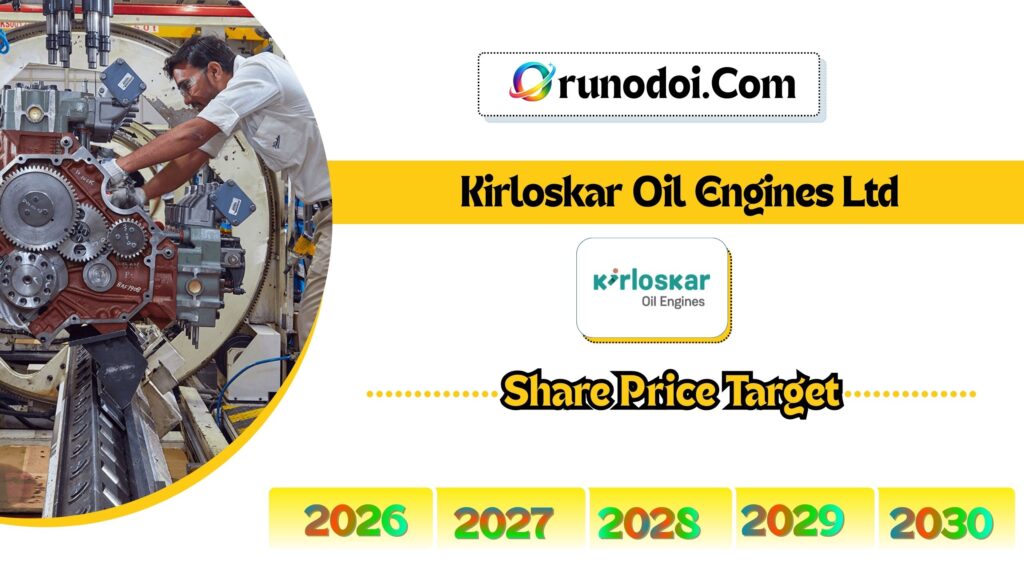
Kirloskar Oil Engines Limited (KOEL) is a flagship company of the century-old Kirloskar Group and a leading Indian manufacturer of diesel engines, generator sets, and pump systems. With a strong presence in agriculture, power generation, industrial, marine, and defense segments, KOEL has built a reputation for reliability and engineering excellence. Backed by consistent order inflows and improving profitability, the company is attracting investor attention as India’s capex cycle gains momentum. This article provides a fact-based analysis of its financials and estimates a realistic Kirloskar Oil Engines share price target for 2026 through 2030.
Rising demand for backup power solutions in data centers, manufacturing, and rural electrification supports order book.
At P/E of ~39x, valuation is premium but justified by quality and execution track record.
Kirloskar Oil Engines Share Price Target 2027
Year
Share Price Target 1
Share Price Target 2
2027
₹1,350
₹1,600
The government’s focus on infrastructure and defense indigenization benefits KOEL’s industrial and marine engine segments.
Expansion in export markets (Africa, the Middle East) could diversify revenue.
If ROCE sustains above 19%, institutional interest may strengthen.
Kirloskar Oil Engines Share Price Target 2028
Year
Share Price Target 1
Share Price Target 2
2028
₹1,450
₹1,750
New product launches (e.g., BS-VI compliant engines, hybrid gensets) may improve margins.
Capacity utilization improvements at Nashik and Kagal plants support scalability.
A low debt-to-equity ratio enhances financial flexibility.
Kirloskar Oil Engines Share Price Target 2029
Year
Share Price Target 1
Share Price Target 2
2029
₹1,550
₹1,900
By 2029, KOEL could benefit from national grid resilience projects requiring distributed power.
After-sales service and spare parts business add recurring revenue.
Brand trust in the Kirloskar legacy continues to drive customer loyalty.
Kirloskar Oil Engines Share Price Target 2030
Year
Share Price Target 1
Share Price Target 2
2030
₹1,650
₹2,100
As a leader in India’s engine manufacturing space, KOEL is well-positioned in a $2+ billion DG market.
However, cyclical demand and competition from Chinese imports cap explosive upside.
Realistic 2030 target assumes EPS of ₹48–52 and P/E of 35–40x.
Strengths vs Risks
✅ Strengths
Trusted brand with 75+ years of engineering heritage
Diversified end-user base (agriculture, industry, defense, marine)
Strong ROCE (19.94%) and improving profitability
Healthy balance sheet with low debt (Debt/Equity < 0.1x)
⚠️ Risks
High P/E (~39x) leaves little margin for earnings disappointment
Sales growth remains sluggish (5.42%) due to sector cyclicality
Exposure to commodity price swings (steel, copper) impacts input costs
Competition from unorganized and imported engine makers
Investment Suitability
Factor
Assessment
Risk Profile
Moderate
Time Horizon
Long-term (5+ years)
Volatility
Moderate
Dividend/Income
Low yield (0.54%)
Ideal Investor
Believes in India’s manufacturing and infrastructure story
FAQs
A realistic range is ₹1,250 to ₹1,450, based on current earnings growth and sector outlook.
We estimate ₹1,650 to ₹2,100 by 2030, assuming steady execution and infrastructure demand.
Reliable forecasts beyond 2030 are not possible. Such long-term projections are highly speculative and not supported by verifiable data.
The Kirloskar Group promoters hold 41.08%. The rest is held by DIIs (28.19%), public (22.27%), and FIIs (8.45%).
Yes – it has a consistent dividend history with a current yield of 0.54%.
The stock corrected due to valuation concerns (high P/E), sluggish sales growth, and broader market rotation away from midcaps in late 2025.
It offers solid exposure to India’s power backup and industrial engine needs, but comes with cyclical risk and premium valuation. Suitable for investors with a 5+ year horizon.
Final Verdict
Kirloskar Oil Engines is a high-quality industrial company with strong fundamentals, brand equity, and improving profitability. While near-term sales growth is muted, its margin expansion and low-debt model provide resilience. Our 2026–2030 price targets (₹1,250–₹2,100) reflect steady, quality-driven compounding—not speculative upside. Investors should monitor quarterly order inflows and export progress as key indicators of future performance.
📌 Disclaimer: These targets are for educational purposes only and are not investment advice. Always consult a SEBI-registered advisor before investing.
Hi, I’m Raj Mittal, a stock market content writer focused on company analysis, share price trends, and fundamental research. I create simple, research-based insights to help investors make smarter market decisions.